|
The Skyline District encompasses most of downtown’s enormous growth during the oil boom from the late 1960s to the early 1980s, before it came all crashing down. After a decade of one of the highest downtown vacancy rates in the country, construction picked up in this area once again in the late 1990s with energy trading companies, such as Enron and El Paso Energy. The district is full of art and architecture, mostly of the post-modern variety, with a few historical sites thrown in.
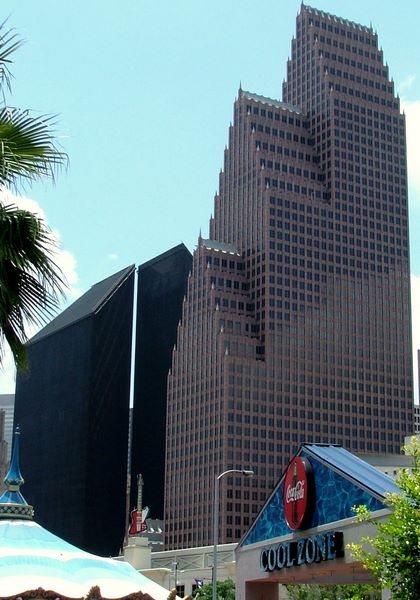
The major attraction in the Skyline District is architecture, lots of modern architecture. The architectural firm of Skidmore, Owings & Merrill (SOM) designed four of the skyscrapers on Louisiana Street - you can trace the firm’s drift from the international-style El Paso Energy Building and One Shell Plaza to the post-modern Wells Fargo Plaza and 1100 Louisiana. The team of Philip Johnson and John Burgee was responsible for two of the buildings on Louisiana, the off-set twin towers of Pennzoil Place and the soaring, neo-Gothic Bank of America Center. Houston’s tallest building, the sleek but plain JPMorgan Chase Tower, is IM Pei’s only contribution to the downtown area. Other notable buildings are the optical illusions of Morris*Aubry Architects, Continental Center I and First City Tower; two post-modern creations of M. Nasr, Wedge International Tower and the Mayan-inspired Heritage Plaza; the infamous Enron Building and the glass tubes of Cesar Pelli's 1500 Louisiana (built as Enron II); and the international style-turned-post-modern CenterPoint Energy Plaza.
Connecting most of these buildings is an underground, air-conditioned labyrinth – the Downtown Tunnel System. Dallas considers their Downtown Tunnel System a source of civic shame; Houston touts theirs as a tourist attraction. Not only do the tunnels siphon-off sidewalk traffic, they are mind-numbing and easily produce insanity as you search in vain for the nearest exit with no inkling of where it will actually disgorge you. If you attempt to cross downtown through the system, and actually do emerge from the labyrinth, you’ve managed to cross the entirety of Downtown Houston in a self-contained, climate-controlled, safe and comfortable environment – the wet dream of urban planners from the 1960s and 70s. Unless you’re up for the challenge, stay above ground.
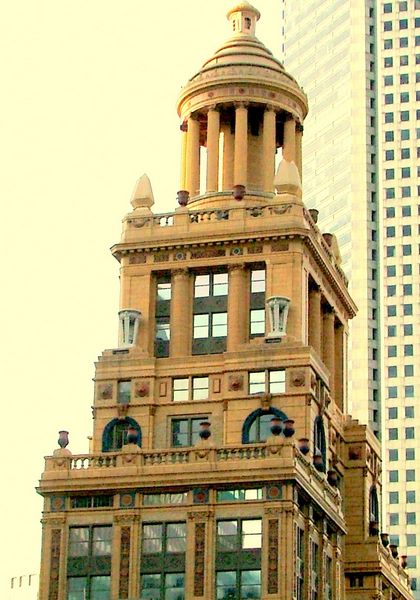
The most dominant buildings in Houston, prior to 1961, were the cupola-topped Niels Esperson Building and the 430-foot Gulf Building. The Gulf Building, the tallest building in Houston for 34 years, contained an observation deck. The observation deck was replaced with a deck on the international-style Exxon Building, erected in 1963. But when One Shell Plaza surpassed Exxon’s height in 1971, the deck was closed. Downtown was without a high-altitude viewing area until the early 1980s, with the openings of the sky lobbies in the city’s two newest and tallest buildings – Wells Fargo Plaza and the JPMorgan Chase Tower.
|
|
|
Main Street, not so long ago the retail nexus of Houston, runs down the center of the district. The only reminder of its former retail glory (other than vacant storefronts) is Foley’s former flagship, Macy's. The building was designed in 1947 by Kenneth Franzheim as a prototype of the modern downtown department store – the only windows on the building are street-level. The blocks to the north of Macy’s have been redeveloped into the pedestrian Main Street Square with artworks, dancing fountains arching over light rail trains, and nightly video shows.
Since this is Houston, even what should be a compact, urban central business district has a tendency to sprawl. A 3-mile walk will take you through most of the district’s major buildings. Come on a weekday from 7am-6pm, when the lobbies are open and the buildings buzzing with workers. The walk covers most of the modern area, with a little bit of history thrown in. Start at the Shops at Houston Center waymark, and follow the links. Make your way over the skywalks through 1 Houston Center to 2 Houston Center - once you get back outside you should be able to pick-up gps reception, unless you venture below ground.
|