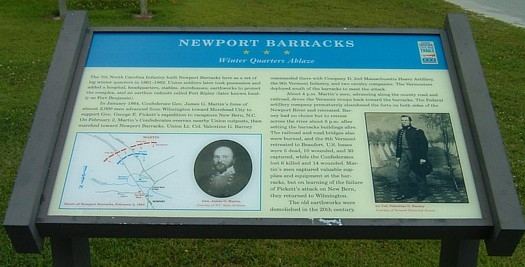
Newport Barracks, Newport, North Carolina
Posted by:  showbizkid
N 34° 47.092 W 076° 51.477
18S E 330005 N 3850758
Newport Barracks were originally built by Confederates in 1861, then captured and greatly improved by Union troops in 1862. The barracks were lost briefly to Confederates in 1864, but then returned to Union hands.
Waymark Code: WMJD4
Location: North Carolina, United States
Date Posted: 07/27/2006
Views: 90
The 7th North Carolina Infantry built Newport Barracks here as a set of log winter quarters in 1861-1862. Union soldiers later took possession and added a hospital, headquarters, stables, storehouse, earthworks to protect the complex and an earthen redoubt called Fort Ripley (later known locally as Fort Benjamin).
In January 1864, Confederate Gen. James G. Martin's force of almost 2,000 men advanced from Wilmington towards Morehead City to support Gen. George E. Pickett's expedition to recapture New Bern, N.C. On February 2, Martin's Confederates overran nearby Union outposts, then marched towards Newport Barracks. Union Lt. Col. Valentine G. Barney commanded there with Company D, 2nd Massachusetts Heavy Artillery, the 9th Vermont Infantry, and two Calvary companies. The Vermonters deployed south of the barracks to meet the attack.
About 4 p.m., Martin's men, advancing along the county road and railroad, drove the Vermont troops back toward the barracks. The Federal artillery company prematurely abandoned the forts on both sides of the Newport River and retreated. Barney had no choice but to retreat across the river about 6 pm after setting fire to the barracks buildings. The railroad and road bridges were burned as well, and the 9th Vermont retreated to Beaufort. U.S. losses were 5 dead and 10 wounded, and 30 captured, while Confederates lost 6 men killed and 14 wounded. Martin's men captured valuable supplies and equipment at the barracks, but on learning of the failure of Pickett's attack on New Bern, they returned to Wilmington.
The old earthworks were destroyed in the 20th century.
To record your own visit to this waymark, take and post your own photo of the waymark with your log. Logs must contain an original photo as proof of your visit, please.