The history of Christianity in Korea can be measured in terms of sacrifice and martyrdom, from the early persecution of Roman Catholic Christians who defied the state established Confucian rites, to the brutal treatment and slaughter of Christians, along with Buddhists and Confucianists, by the Japanese during the years of harsh occupation in the twentieth century. For more than two centuries the Christian faith has woven itself as a strong strand into the Korean culture.
When the French missionary Xavier Baudonet undertook the building of this Cathedral in 1908, it was conceived of as a memorial to those who had been martyred for their faith at this very spot.
<center)
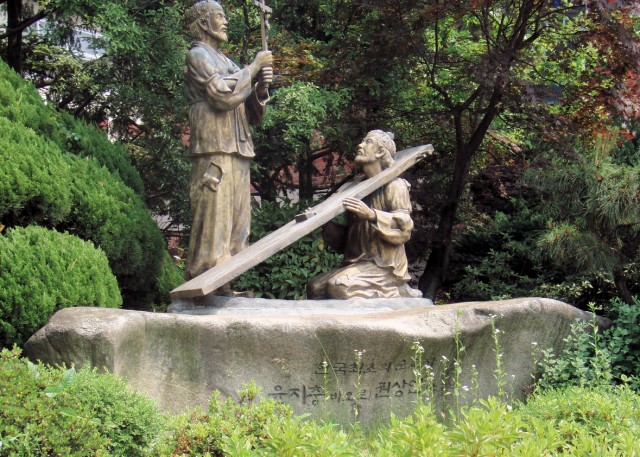
The Martyrdom of Yun Chi'-ch'ung and Kwon Sang-yon December 8, 1781
When Yun Chi'-ch'ung and Kwon Sang-yon, were executed on this spot on the 8th of December, 1781, they become the first Korean Christian martyrs. This city of Jeonju was the traditional seat of the Joseon Dynasty that ruled Korea up until the independence movement in the early twentieth century, and the Christian faith was seen as a threat to the state established Confucian system with its rites of ancestor worship.
On the 17th of September, 1801 (one source gives the date Oct 24), Biship Yu Hang-gom, who was the founder of the Catholic Church in this area, and several other leaders of the early church were also executed here.
Five of those executed were:
Yu Hang-gom (Augustine, age 46)
Yun Ji-heon (Francisco age 38)
Kim Yu-san (Thomas age 41)
Yu Gwan-geom (age 34)
Lee Woo-jim (age 40)
<center)
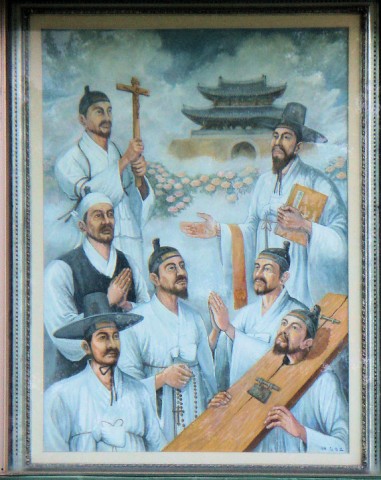
The Bishop's head was hung from the nearby South Gate (Pungnam-mun)of the city of Jeonju. It is said that the cornerstone for this building came from that gate, symbolizing that the church is built on the blood of martyrs. Other sources recount more of the history of Christian martyrdom in Korea.
Korean Martyrs
<center)
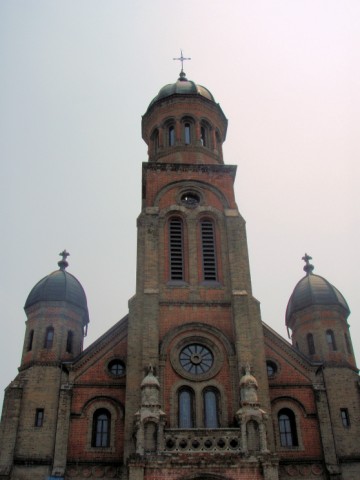
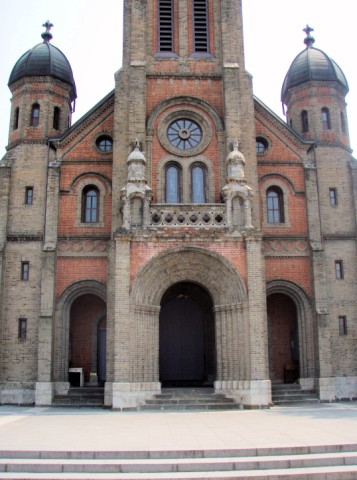
It is built in the impressive Romanesque style with red brick, high arched entry ways and a central bell tower flanked by domed towers.
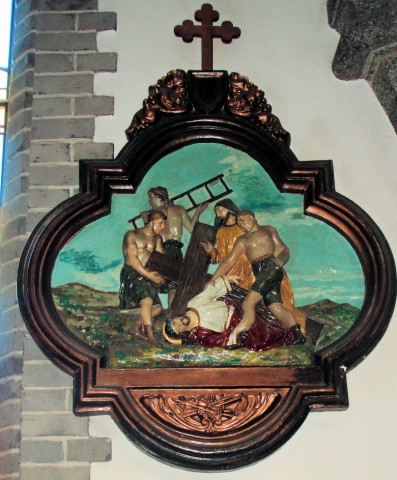
The interior is lavishly finished with stained-glass windows, and hand carved stations of the cross. It is the largest western style building in the north and south Jeolla Provinces. It is regularly open for visitors and tours.
In recent years, these martyrs have come to be recognized by Koreans and true heroes who sacrificed their very lives for their faith. The Korean government has designated this site as National Treasure No. 288.
<center)
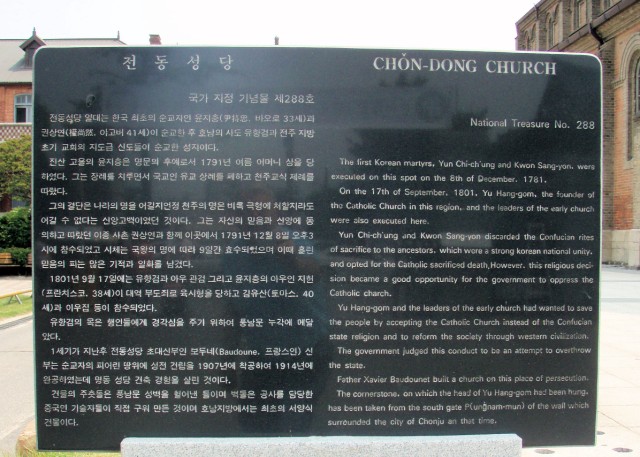
National Treasure No. 288
The first Korean martyrs, Yun Chi'-ch'ung and Kwon Sang-yon, were executed on this spot on the 8th of December, 1781.
On the 17th of September, 1801, Yu Hang-gom, the founder of the Catholic Church in this region, and the leaders of the early church were also executed here.
Yun Chi'-ch'ung and Kwon Sang-yon discarded Confucian rites of sacrifice to the ancestors, which were a strong Korean national unity, and opted for the Catholic sacrificed death. However, this religious decision became a good opportunity for the government to oppress the Catholic church.
Yu Hang-gom and the leaders of the early church had wanted to save the people by accepting the Catholic Church instead of the Confucian state religion and to reform the society through western civilization.
The government judged this conduct to be an attempt to overthrow the state.
Father Xavier Baudonet built a church on this place of persecution.
The cornerstone, on which the head of Yu Hang-gom had been hung, has been taken from the south gate P(ungnam-mun) of the wall which surrounded the city of Chonju at that time.
<center)
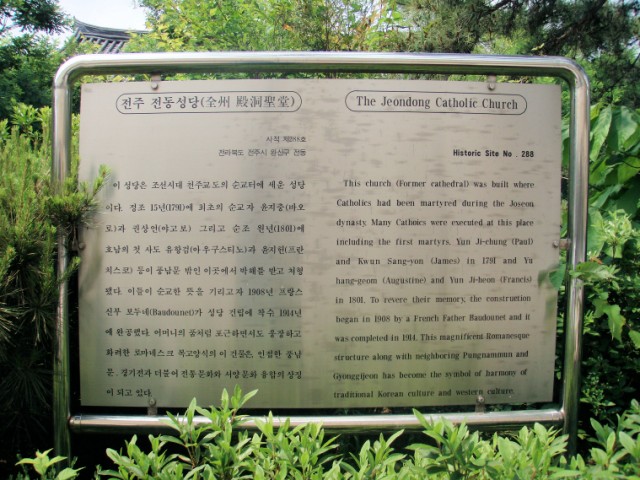
The Jeondong Catholic Church
Historic Site No. 288
This church (Former Cathedral) was built where Catholics had been martyred during the Joseon dynasty. Many Catholics were executed at this place including the first martyrs. Yu Ji-chung (Paul) and Kwun Sang-yon (James) in 1791 and Yu hang-geom (Augustine) and Yun Ji-heon (Francis) in 1801.
To revere their memory, the construction began in 1908 by a French Father Baudounet and it was cempleted in 1914. This magnificent Romanesque structure along with neighboring Pungnammun and Gyonggijeon has become the symbol of harmony of traditional Korean culture and western culture.
Two later additions on the grounds of this historic church are these two sculptures - Christ with his arms outstretched and a replica of Michelangelo's
La Pieta. No information as to their artists or date of their creation is readily available.