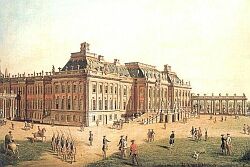
 The Castle in 1751
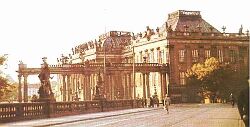
View from Long Bridge in 1888
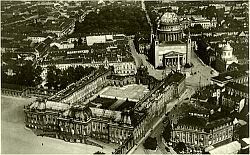 Aerial view in the 1930s
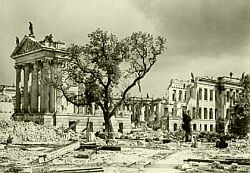 Ruins after the bombing in 1945
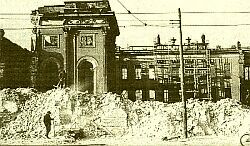 Remains before demolition in 1959
 |
Since 1751, the Potsdam City Palace was the official winter residence of the Prussian Kings, and, starting in 1871, the German Emperors (Kaiser). The location has been the site of several fortresses and castles since the times of the Roman Empire. Slavic tribes that lived in the area until the mid of the 12th century built a fortress here in 993 to guard a nearby river passage called Poztupimi. The current name of the city (Potsdam) was derived from this ford and fortress.
In 1157, the Ascanians conquered the area and enhanced the fortress. But at the end of the Middle Ages, the fortress decayed until it finally was torn down and rebuilt 1589. However, it wasn't used much and for a while in the early 17th century, it was even turned into a barn.
In 1660, Frederick William, duke of Prussia and Elector of Brandenburg started a massive reconstruction and eventually moved his entire court into the new building in 1671. The castle got it's final shape by King Frederick II and Architect Georg Wenzeslaus von Knobelsdorff in 1751 and until the end of the German Empire in 1918, the German Emperors resided here at least for parts of the year.
After 1918, the building was turned into a museum and later also hosted offices of the city administration. During an allied bombing attack on 14th April 1945 the City Palace was burned out and in 1959, the remains were pulled down. Most sources today simply state that Communism and Castles just don't mix and that the East German communist government ordered the destruction of the castle for ideological reasons. The whole story, however, is a little bit more complex:
Prussia, and especially Potsdam was considered to be the cradle of German Militarism. Dismantling a place that in a sense was the starting point of two World Wars was supposed to send a signal to the world that post-war Germany had honestly broken with its past. However, it is a shame that the crown jewel of Friderizian Rococo got lost forever.
In 2013, a new building, resembling the original facade of the castle has been completed.
|