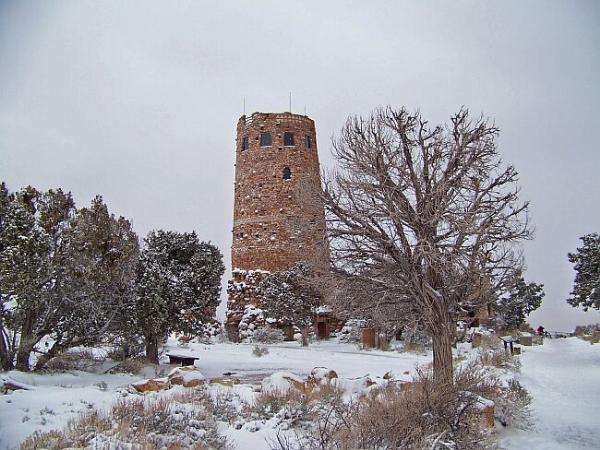
Desert View Watch Tower, Grand Canyon, Arizona
N 36° 02.628 W 111° 49.558
12S E 425597 N 3989122
Famous Watch Tower overlooking the Grand Canyon
Waymark Code: WM13PX
Location: Arizona, United States
Date Posted: 01/05/2007
Views: 290
Build a structure that provides the widest possible view of Grand Canyon yet harmonizes with its setting: this was architect Mary Colter's goal when the Fred Harvey Company hired her in 1930 to design a gift shop and rest area at Desert View. Colter's answer was the Watchtower.
A perfectionist, Colter scrutinized every detail, down to the placement of nearly every stone. Each stone was handpicked for size and appearance. Weathered faces were left untouched to give the tower an ancient look. With a lavish, highly publicized dedication ceremony, the Watchtower opened in May 1933
This text was taken from scienceviews.com. It can also be found a Marker near the tower describing its history in detail.
Click on the pictures for larger images
The Desert View Tower marks the easternmost end of Grand Canyon National Park. It has a huge parking lot and nearby are a book store, a souvenir store a cafeteria and restrooms. In the summer it can get pretty crowded here, so if you really want to enjoy the tower and its art work, come in the winter.
Click on the pictures for larger images
The uppermost observation area has a complete floor area covering the circular plan, and large plate-glass windows overlooking the surrounding expanses of the vast southwest. Downside in the winter: the weather is unpredictable. In the morning, hiking the western part, we had a clear view over the canyon, but once we made it to Desert View, there wasn’t much of a view left. Hopefully, the next visitors of the waymark can submit better pictures of the truly amazing view.
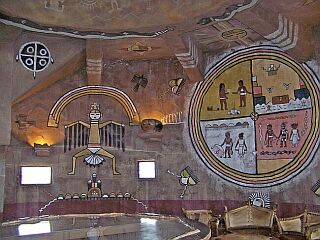 |
The most architecturally impressive section of the building is undoubtedly the tower interior. The space is an open shaft surrounded by circular balconies edging the walls and small staircases that lead up to subsequent levels. The steel and concrete structure of this space is entirely plastered and all of the walls are covered with murals.
The most distinct images, painted by Hopi artist Fred Kabotie depict various aspects of Hopi mythology and religious ceremonies.
Experiencing the multiple levels and circular balconies and the hundreds of prehistoric images inundates the viewer with an overwhelming sense of the southwest. |